
Planning a Family Conservation Morning at an Outdoor Club
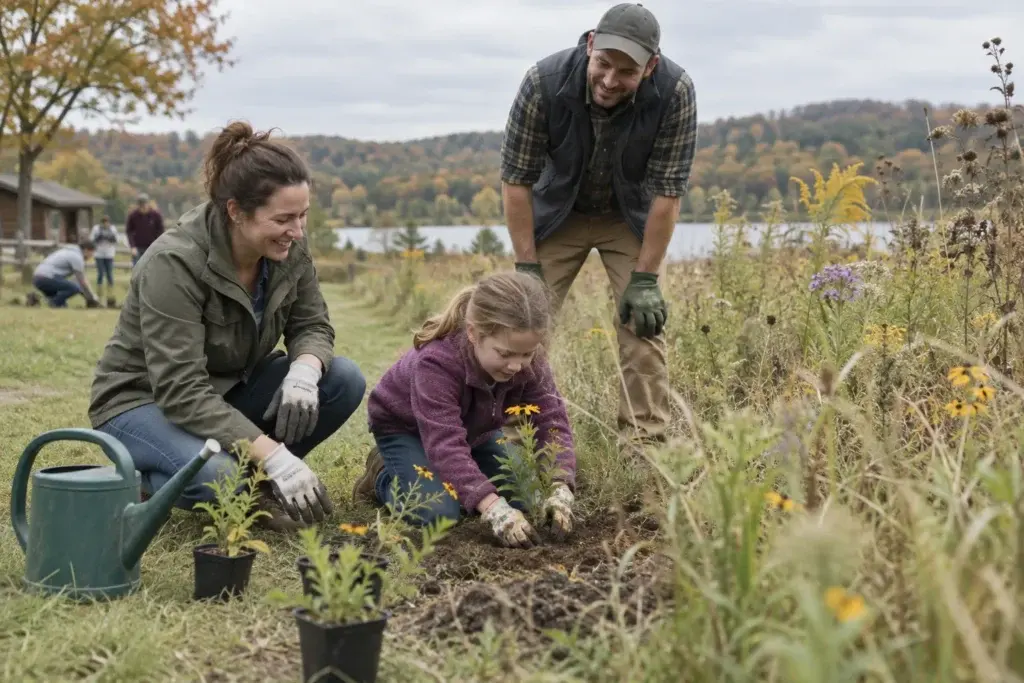
A family conservation morning can be worthwhile without turning into a large event. A few people who work on a clearly defined task with a realistic finish time and someone who knows the place can do more than a crowded day built on vague enthusiasm. For a community that's part of an outdoor club, the planning starts with permission and a suitable job. Just because land looks untidy does not mean clearing it is helpful or allowed.
The ideas here are for planning a volunteer activity with the organizer. They are not an announcement of a Byron event. Check the club’s calendar and contact the organizer before arriving or inviting other families. The land manager’s instructions should decide the task, the boundaries and the equipment. A general article cannot say which plants belong on a site or decide whether a patch of vegetation should be removed.
Ask what would actually help
Start with the person who's responsible for the grounds. Ask whether there is a task that's suitable for a small family group and whether someone will supervise it. A defined job might be more useful than a project suggested by visitors. It should have a location, a clear end point and instructions that everyone can understand. If the organizer cannot offer a task that day, choose another date instead of inventing work on the spot.
Be specific about the group you are bringing. The number of adults, the children’s ages and any access needs affect what can be planned. Do not describe children as extra labor and let the organizer discover their needs on arrival. There should be a role for each participant, including anyone who needs a seated or less demanding activity. A smaller group with a good fit is often easier to supervise than a large group with unclear expectations.
Agree on boundaries before discussing tools
Know where the activity takes place and which areas are out of bounds. At a club, other activities may be happening at the same time. Families should follow the site’s separation and supervision rules and stay within the area assigned by the organizer. Do not assume that a path is open simply because it looks quiet or that somebody in another part of the grounds knows that a volunteer group is nearby.
Ask where vehicles should be parked, where the group will meet and whom to contact if a participant arrives late. A simple arrival plan prevents people from wandering through grounds looking for the activity. If a child needs to leave the work area, a responsible adult should accompany them according to the organizer’s arrangements. These details may feel mundane, but they are part of making a morning relaxed enough for people to enjoy returning.
Choose a task children can understand
A useful explanation links the activity to a visible result without promising more than you know. An organizer might explain where approved plants will go or which litter can be collected safely. Children should know what they are allowed to touch, what they should leave alone and when to ask for help. If identifying a plant is part of the task, the identification should come from a competent supervisor, not a guess based on a phone photograph.
Keep children away from sharp, heavy, powered or chemical equipment. Let a qualified organizer select activities and materials appropriate to their ages and abilities. There are plenty of ways to participate without using such equipment. A child might help with an approved planting task alongside an adult or assist with a simple observation activity. The goal is participation that fits the child, not a photograph of everyone apparently doing the job regardless of age or ability.
Let the site determine the planting
Do not arrive with a tray of plants and assume they belong in the ground. The right plants depend on the location and the land manager’s plan. Even good intentions can lead to extra work if the species, placement or care later is not right for the site. Always ask what materials are needed before buying or bringing anything. If the organizer has not approved a planting task, choose another way to help instead of treating spare plants like a donation that must be used.
The U.S. Fish and Wildlife Service lists ways people can support conservation, such as volunteering and working with partners. Their examples can give ideas about the kinds of activities that exist. They do not give permission to act at a local club or set a planting list. Use resources to ask clear questions. The person in charge of the site still needs to decide if an idea fits the land, the season and the care that can be provided afterward.
Plan a session with a real break
Work out a reasonable length of time with the organizer. Leave room for the briefing, breaks and cleanup. Families may prefer a focused session over an open-ended morning that goes past lunch. Tell participants what conditions to expect and what the organizer recommends they bring. Check if drinking water, toilets, shelter and a proper rest area are available, rather than assuming every outdoor site has them.
Weather can change the task or make it unsuitable. Ask how cancellation or a change in plans will be communicated. Check the message before you head out. A family should be able to leave early if someone feels uncomfortable or tired—without feeling they have failed. Discuss this ahead of time. The success of the event is not about keeping everyone outside for the longest time, especially when the group includes young children or people with different needs.
Keep the briefing practical
A short demonstration from the organizer should cover the task, the allowed equipment and the point at which participants should stop and ask for help. Confirm how to report an injury, a hazard or an unexpected object. Volunteers should not handle discarded sharp objects or unidentified materials simply to keep the area looking tidy. Report them. Follow the site’s instructions. Good intentions do not make an object safe to pick up.
Check understanding in a straightforward way. Ask a child to explain which area they will stay in or what they will do if they are unsure about a plant. Adults should follow the boundaries even when they have experience elsewhere. Familiarity with gardening or outdoor work does not mean knowing this site’s plan. The briefing is a chance to align the group before work begins, not a formality to get through as quickly as possible.
Finish the task before taking the photograph
Allow time to return equipment, collect approved waste and show the organizer what has been completed. A task is not finished merely because the visible planting looks attractive. The organizer may need to know where work stopped or which part still requires attention. Pass on those details clearly. If follow‑up watering or another visit is needed, agree on who will handle it rather than assuming that an unnamed volunteer will notice later.
Photographs should respect participants and the site. Ask permission before sharing images, especially pictures of children, and follow the organizer’s policy. Avoid presenting a volunteer image as evidence of a particular club event that did not take place. A useful record can be a description of the task and the follow‑up agreed. The record need not reveal personal information or imply that a small morning’s work has already produced a measurable ecological result.
Give the family a reason to return
After the activity, ask each participant what they understood about the task and what they enjoyed. A child might recall seeing an insect or recognizing a plant more clearly than the number of things the group planted. Those observations can turn into questions for a future visit with the organizer’s permission. Do not promise a wildlife sighting or a dramatic transformation. Conservation work usually asks people to notice over time rather than expect an instant show.
Thank the organizer and keep any commitment small enough to fulfill. Returning a borrowed item promptly or completing one approved task matters more than giving a long list of future projects. A good family volunteer morning leaves the site in the agreed condition and the group clear about what it contributed. That is a basis for another visit: useful work, realistic expectations and a growing interest in the place instead of a one‑day performance.