
Recording Volunteer Hours and Skills at a Conservation Club
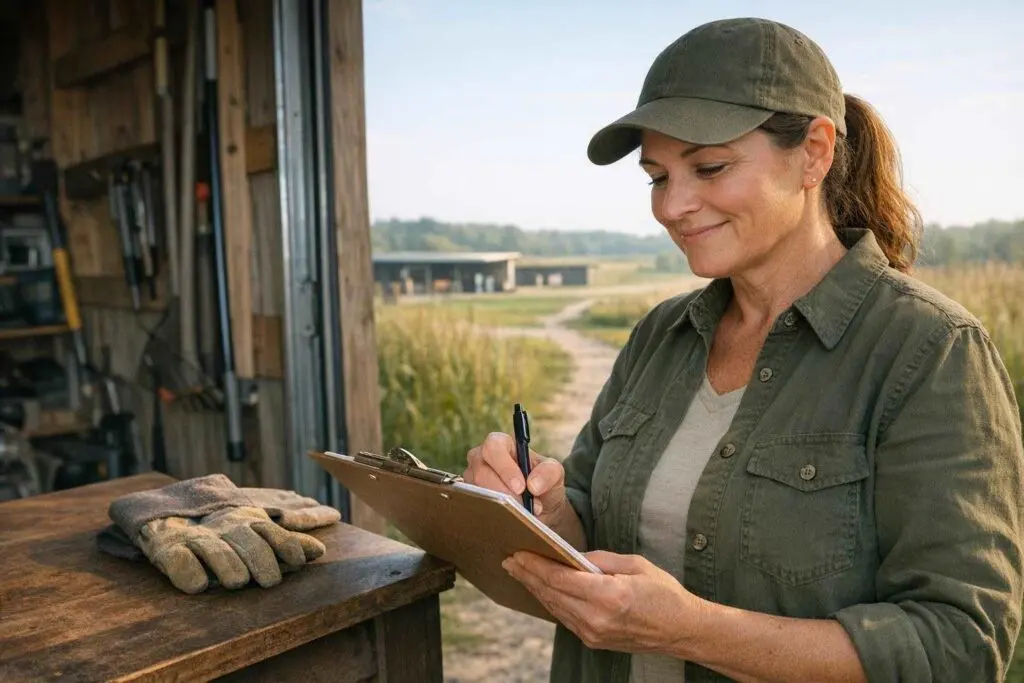
It is easy to remember a conservation project but difficult to document it. Remembering that a Saturday had been spent clearing fallen branches from along the club's access road did not mean that a record was automatically kept of everyone who had attended on the day and for how long they had worked. Their equipment used and their skills put to use had also to be recorded and that work logged and followed up afterwards.
Start with the workday, not the spreadsheet
Look at this from the viewpoint of Jordan, the volunteer coordinator for a mixed outdoor and shooting club who has set up for a single day's project: a simple clearing of fallen branches to reveal the blocked footpath through the scrub, a look at the drainage round the storage area and a thorough litter clear along the edge of the property. Others have gone off to do various Club jobs and will join this session later in the day.
Reporting a single total hour for a day's work would be to obscure many useful details. Jordan needs a simple attendance note for each person indicating the time they arrived and left (or agreed work session length) and detailing the Project Name, Date and Work Area in which they worked. Whoever confirmed that volunteer's attendance can also be noted.
Whether or not to record how long a volunteer was away from the session for example, to count time helping to set up for an event, or time spent administrative work in respect of a conservation project, are all questions that need to be addressed by the club in advance. Unless a club has identified what it regards as volunteer time in advance, such time is likely to be recorded inaccurately.
Decide what qualifies as volunteer time
Some unpaid work done by clubs includes habitat maintenance, litter picking, event setting up, club administration, checking club equipment, assisting with club instruction/orientation etc. All of these should ideally be recorded differently to other types of volunteer work in order to allow for easier analysis of where efforts have been spent.
Choose the categories that are relevant for your club. Often a simple list of the types of work that volunteers do for your club will suffice. These categories need to help you work out where members' time has been spent and to help to argue that members' time should be counted. Examples of categories are: conservation work, site maintenance, event support, club governance, training of club members to help with specific tasks.
Consider the occasion when a volunteer only attends for part of the service time, leaves before the session finishes or is away from the group for breaks. For such instances recording start and end times for attendance could be more suitable than asking volunteers to estimate a whole number of hours for their attendance at a session. Coordinate a method of estimation for groups of volunteers and then state how you have estimated the hours for that group – e.g. coordinator's estimate.
Separate requirements may exist relating to the club's grants, insurance, employment status etc. that may demand service time to be recorded in a particular manner. The club officer responsible for this area of club administration would need to verify the club is complying with current official guidance in respect of recording service time for club administrative purposes and for reporting purposes to public bodies.
Record skills as evidence, not labels
Whilst hours of participation are recorded, skills are recorded in detail in order to accurately report volunteer's skills and in order to assign the most suitable task to volunteers.
The same problem occurs with skills. Instead of having Jordan record that Casey did drainage inspection, Morgan did hand-tool work under the site lead for the day's work, and Lee led a waste sorting session as part of the litter removal project, you record that they did 'drainage inspection' for example, and then later try to determine what other skills they might have. This is especially problematic in your club as outdoor work is often combined with shooting sports and different people will have different skills for different activities.
It would also be useful to distinguish between outdoor conservation work and shooting-related activities, and to note that people with skills for site logistics, first-aid, vehicle co-ordination and range administration, for example, may have no experience of or skill for habitat work. And that people with skills for habitat work may have no experience of or skill for other activities.
The simple skills register should detail: the skills demonstrated by the volunteer, the level of responsibility that they have worked under and their interest in using that skill again for future volunteer activities. As with all skills which relate to safety, machinery, driving, first aid or other regulated activities it is also wise to check the club's policies and current official requirements prior to delegating responsibility to any volunteer.
Make volunteer records easy to verify
Whatever method you use for recording hours, it should ideally have two layers: an easy method for recording hours during an event and a method for checking the occasion-wise records afterwards (e.g. occasional sorting of hours). The method for recording hours during an event can be paper or digital (e.g. online form). The method for checking the occasion-wise records afterwards can be digital (e.g. spread-sheet).
You just need to collect enough information to create a complete record of what the group have done. Remember to include project name, date, attendee names, duration of time at session, category of work undertaken, any relevant skills used. Allow space for any special notes relating to that session (e.g. late arrival, switched to another task etc). Keep these brief and factual.
It is very important to verify an hour or so after the session has finished, against the work leader's notes for the session. any errors found can be amended immediately, with full transparency as to who made the change and why. A volunteer should be able to check the exact date and time that they signed up to attend a session and also to query an entry that they believe to be inaccurate.
Remember that you only need to collect information that your club needs to function and record information in a way that is private to the volunteer recording the time and skill. Restrict access to the recorded time and skill to those who need to use the information for administration and track how recorded information is used and stored.
Keep administration proportionate
An appropriate database for recording a conservation club's volunteer work is unlikely to be complex to operate. It is more important to get the design of the form to record the data, and the naming of the categories for recording hours, etc., right. Then make sure that all necessary fields for a particular purpose are included and that all can be completed by volunteers.
Q4: What decision does each field support? Remove fields that don't support decisions about confirm attendance, future work, project activity or reporting requirements. Use the same names for projects and categories for tasks every time you record a session.
Distinguish the roles within your club for collecting, verifying and summarizing attendance for future use. Record keeping should be a set of tasks assigned to volunteers and distributed between one or two people. In a very small club all these roles can be filled by a single person, so it's worth noting who currently acts as Record Keeper etc.
Use the record to plan the next job
After the volunteering session has taken place it becomes clear that the path project had plenty of people attending sessions to build paths but very few people have experience of carrying out drainage checks. So for the next session on this project a short briefing will be given to inform volunteers of the task in hand and then they will be allocated different tasks, possibly with the assistance of someone more experienced in this type of work.
Every contribution to a conservation club is mostly physical work in the outdoors. This must be recorded against the skills he/she/they have demonstrated (to identify when they can be given further responsibility). The record will reveal the hidden contributions of sign in, tool preparation and project administration. In many cases the members are contributing quietly and behind the scenes to enable the physical conservation work to take place.
Summary: keep it short and readable. A simple list of project, date, people, hours, skills and actions is best for sharing outside of the secure personal records. It should help the next volunteer day to become clearer, safer and more organized, not just bigger.